Wednesday, November 12, 2014

all spruced up


1931 displayed the first Christmas Tree in Rockefeller Center, set up by grateful construction workers building 30 Rock. 

You can see St. Patrick’s in the background.
ap
That first tree was only 20 feet tall and decorated with paper garlands, strings of cranberries and tin cans. It was the Great Depression.


For the workmen times were tough,                             but at least they had a paying job.

There was no tree in 1932. 
The first ever “official” tree was erected in 1933, twice the height of the first one and decorated with 700 electric lights.

During the war years of 1942-45 trees were erected but decorated in “nonessential materials”, because every scrap of steel and glass went to the war effort.

In 1973 the gas and oil shortage reduced the number of lights and the hours that they burned.


1999 saw the tallest tree on record, a 100’ Norway Spruce from Connecticut. 


Today the tree averages about 80 feet high and 13 tons. 

It sports a 9 foot crystal star and features over 45,000 LED string lights powered by solar panels on nearby buildings.


The theoretical limit, by the way, is 110 feet because 90〫turns in the streets leading to Rockefeller Center can’t accommodate anything taller than that.


This year, the tree is from Pennsylvania.
The Lighting Ceremony is scheduled to take place on the 3rd of December. C'mon down.

2010


Tree’s company!

Tuesday, November 11, 2014

and the day after that, as well


Back in 2002, artist Cindy Kane was moved by the death of Daniel Pearl, the American journalist who was kidnapped and murdered in Pakistan.

vineyardgazette.com

In May of 2011, 
SPRINT launched the Flatiron Prow ArtSpace.


Attached to the 1902 FLATIRON, the glassy retail space was added at the time to help defray galloping construction costs.


Today, it showcases art.

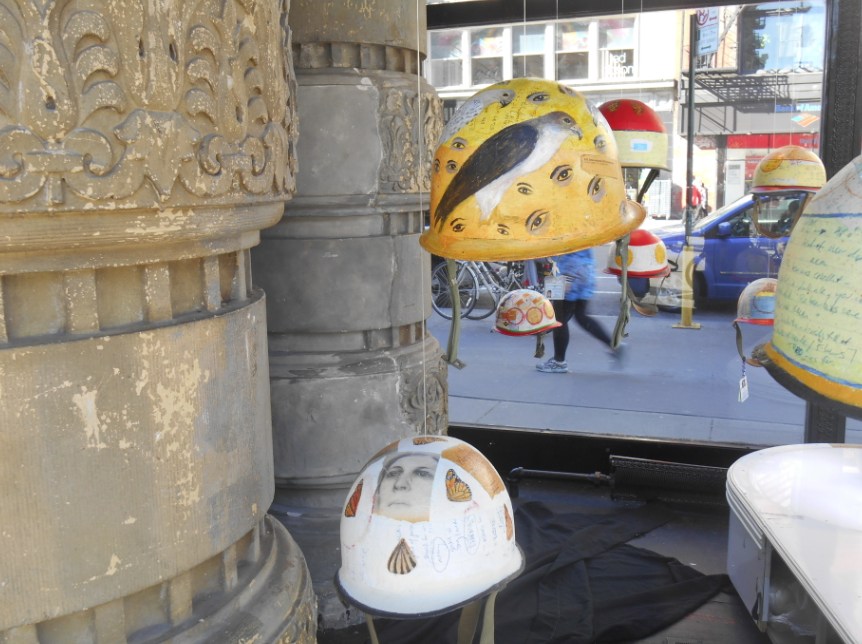
The Helmet Project features 50 used, steel military helmets from the Vietnam War era.


Kane contacted journalists and asked them to send her paper relics from the wars they’ve covered.


She was overwhelmed when notes and photographs, airline tickets, even Band-Aids, arrived from foreign correspondents who had been through war overseas. 


She paints the helmets white, then covers them with the paper detritus of war. 


Then she adds her own artistic touches — color, imagery, little figures, paintings of butterfly wings and eyes. 


The only package she couldn’t work with and returned was from the Muslim journalist whose house Mr. Pearl was staying in, at the time of his kidnapping. 


“I couldn’t bear to touch it, so I sent it back,” 
she said quietly. 


If you know a veteran of foreign war, 
give them your thanks today. 


Tomorrow, too.

Sunday, November 9, 2014

build a bridge and


wing and a prayer


Separation of Church and State is enshrined in our Constitution, but down on State Street near the Battery there’s no division.

The Church, in this case, sits right on State.


When built, #7 State was actually on the water. 

All below the redline is actually landfill from before the 1900’s.


This was once a row of wealthy private residences, bathed in cooling breezes that came off the New York harbour.

libraryofcongress

The occupants could monitor harbor traffic, too, keeping tabs on their importing businesses.

nationstate.net

Over the centuries all the houses but #7 were torn down.


Built in 1793, the eastern portion (on the right) was home to James Watson and is the last example of the elegant Federal Style along the harbour.


In 1806 the curved wing of columns was added by architect John McComb, the same man who designed City Hall and Gracie Mansion.

libraryofcongress

It is said he reused masts as columns on the front of that wing, recycled from sailing ships undergoing steam conversion.


In 1870 the Roman Catholic Church purchased #7 for $1. It served as a hotel until 1886, the year of our ClockTower, when it became the Mission of Our Lady of the Rosary.


Disaster struck the Titanic in April of that same year. The First Class survivors were soothed at the Waldorf Hotel. Steerage found temporary sanctuary here.

nytimes

Eventually the church sold air rights for $6,000,000 to the glassy boxes that now flank it, and in 1965 built the attached chapel in the same Federal style as #7.  


This faux Georgian chapel now uses Watson’s house as a rectory.


The James Watson House is the very last residence from the Federal Period in the Financial District.


Let us pray it survives!